
LTPO Super Retina XDR OLED
12
256 / 512 / 1024
Triple 48MP Pro Fusion: 48MP wide (f/1.78, 24mm, sensor-shift OIS) + 48MP ultrawide (f/2.2, 13mm) + 48MP telephoto (f/2.8, 100mm, 4x optical)
Apple A19 Pro (3nm)
3988
6.3
LTPO Super Retina XDR OLED
2622 × 1206
120
3000
Dolby Vision, HDR10, HLG
Ceramic Shield 2 (front)
Triple 48MP Pro Fusion: 48MP wide (f/1.78, 24mm, sensor-shift OIS) + 48MP ultrawide (f/2.2, 13mm) + 48MP telephoto (f/2.8, 100mm, 4x optical)
18MP Center Stage (f/1.9, 23mm)
4x optical in, 2x optical out, 8x optical zoom range, up to 40x digital
4K Dolby Vision up to 120fps; ProRes, ProRes RAW, Log; Dual Capture (front+rear)
Yes (Photonic Engine; no Night mode portraits)
Yes — sensor-shift OIS (main), 3D sensor-shift OIS (telephoto)
Apple A19 Pro (3nm)
6
Apple GPU (6-core)
12
256 / 512 / 1024
NVMe
No
149.6 × 71.4 × 8.75 mm
204
Aerospace-grade aluminum unibody; Ceramic Shield 2 front
IP68 (up to 6m for 30 minutes)
Cosmic Orange, Deep Blue, Silver
3988
50% in ~20 min (40W+ USB-C PD)
Yes — MagSafe 25W, Qi2 25W
No
Up to 33 hours video playback
5G (sub-6 GHz and mmWave), Gigabit LTE, UMTS/HSPA+, GSM/EDGE
Dual eSIM (US model; no physical SIM tray)
6.0 (A2DP, LE)
Wi-Fi 7 (802.11be), 2x2 MIMO
Precision dual-frequency GPS (L1+L5), GLONASS, Galileo, QZSS, BeiDou, NavIC
Yes (reader mode, Express Cards, Apple Pay)
USB-C 3.2 Gen 2 (up to 10Gb/s), DisplayPort
US unlocked and carrier models
iOS 26
iOS (Liquid Glass design)
No fixed window published; iPhones historically receive 5-7 years of iOS and security updates
9923 (GeekBench v6, GSMArena lab)
2430575 (AnTuTu v10, GSMArena lab)
The A19 Pro with vapor-chamber cooling is Apple's strongest gaming phone yet; ray-traced titles sing (our testing)
Vapor chamber + aluminum unibody spreads heat across the frame for sustained performance (Apple)
Up to 33 hours video playback (Apple)
Wired, PD3.2, AVS, 50% in 20 min; 25W wireless MagSafe/Qi2 (GSMArena spec)
-28.9 LUFS (Average, GSMArena lab)
As with every iPhone, Apple publishes no PWM dimming specification
204
8.75
Aerospace-grade aluminum unibody; Ceramic Shield 2 front
No (Face ID)
Apple rates Ceramic Shield 2 as 3x more scratch-resistant than the previous generation
Linear resonant actuator (Taptic Engine)
Haptic (Taptic Engine); Camera Control with haptic click
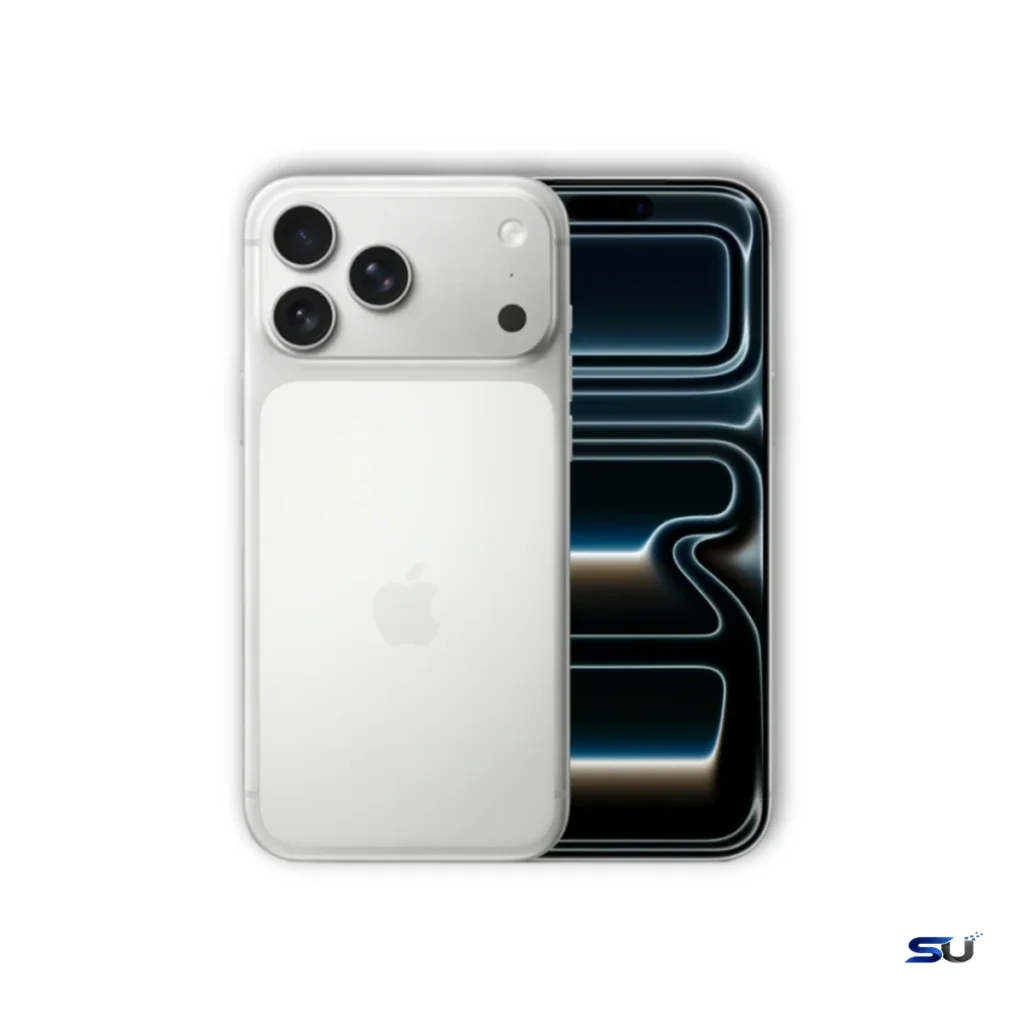
You don't need the Max to get the best. The Apple iPhone 17 Pro 12GB packs the A19 Pro, the new aluminum unibody, and the 48MP telephoto into a 6.3-inch frame — Apple's pro camera system for smaller hands.
You don't need the Max to get the best. The Apple iPhone 17 Pro 12GB packs the A19 Pro, the new aluminum unibody, and the 48MP telephoto into a 6.3-inch frame — Apple's pro camera system for smaller hands.
For years, the smaller Pro lived in the Max's shadow. It carried the same chip but a smaller battery and, in some generations, a weaker zoom. That compromise is gone. The 17 Pro gets the same A19 Pro silicon, the same triple 48MP camera array, and the same forged aluminum unibody as its bigger sibling. What you give up is screen size and some battery capacity — nothing else.
It starts at $1,099 with 256GB of storage, which lands it $100 below the Pro Max. You also get 12GB of RAM, the most memory Apple has put in a non-Max iPhone, and iOS 26 out of the box. On paper, this is the complete pro package, sized for people who don't want a 6.9-inch slab riding in their pocket.
The 17 Pro looks different from every Pro before it, and the reason is the frame. Apple moved from titanium back to aluminum, forging the whole chassis — including the camera plateau — from a single piece of metal. The result is a unibody with no separate camera island glued on top. Apple says the design spreads heat better, which helps the A19 Pro hold its peak speeds for longer.
It measures 149.6 × 71.4 × 8.75 mm and weighs 204 grams. That's 29 grams lighter than the Pro Max and noticeably easier to use one-handed. The flat sides are still there. However, the edges feel softer than the sharp rails of the titanium era. Three colors are on offer: Cosmic Orange, Deep Blue, and Silver. The orange one is loud — the most colorful Pro Apple has made in years — while the other two play it safe.
Water and dust resistance is rated IP68, good for submersion up to 6 meters for 30 minutes. The front is Ceramic Shield 2, which Apple claims is three times more scratch-resistant than the previous generation. There's no fingerprint sensor — Face ID handles unlocking — and the Camera Control button returns with haptic feedback alongside the Action button.
The 6.3-inch LTPO Super Retina XDR OLED on the Apple iPhone 17 Pro 12GB runs at 2622 × 1206 pixels, which works out to about 460 pixels per inch. ProMotion takes the refresh rate from 1Hz all the way to 120Hz. As a result, scrolling stays smooth while static content sips power. Peak brightness hits 3,000 nits outdoors. In addition, HDR content is supported in Dolby Vision, HDR10, and HLG.
Always-on display is here too, dimming down to 1Hz when the phone sits idle. Meanwhile, the Dynamic Island remains, housing the TrueDepth camera and Face ID sensors. Bezels are thin and even on all four sides, which makes the slightly taller 6.3-inch panel feel bigger than the number suggests. Text looks razor-sharp. For example, small fonts in long articles stay crisp without zooming, and colors stay accurate without the oversaturated look some rivals default to.
One thing to know: this is the same display technology as the Pro Max, just smaller. There's no downgrade in brightness, refresh rate, or color support for choosing the 6.3-inch size. If you found the Max too big but still wanted the best screen Apple makes, this is exactly that.
The A19 Pro is built on a 3-nanometer process and pairs a 6-core CPU with a 6-core GPU. Apple also doubled down on cooling this year. First, a vapor chamber sits inside the aluminum unibody, pulling heat away from the chip during long sessions. The practical upshot is that games, video exports, and on-device AI features should run at full speed for longer without the phone getting uncomfortably warm.
Then there's the RAM. With 12GB on board — up from 8GB in last year's Pro — the 17 Pro has real headroom for Apple Intelligence features, which lean heavily on memory. Multitasking between heavy apps, editing 4K video, and jumping back into games should all feel instant. Storage starts at 256GB and tops out at 1TB, using fast NVMe storage throughout. There's no microSD slot, so pick your capacity carefully at checkout.
Graphics get a boost too. The 6-core GPU supports hardware ray tracing, which matters for the growing list of console-class games on iOS. Combined with the 120Hz display, fast-paced titles look fluid. Apple doesn't publish clock speeds or benchmark targets. Still, real-world speed is best judged by how quickly apps launch and how smoothly everything scrolls — and the A19 Pro has overhead to spare on both counts.
Here's where the Apple iPhone 17 Pro 12GB really earns its name. All three rear cameras now use 48MP sensors: a 48MP Fusion main (24mm, ƒ/1.78), a 48MP Fusion ultrawide (13mm), and a 48MP tetraprism telephoto (100mm, ƒ/2.8). That last one is the big deal — it brings genuine 4x optical zoom to the smaller Pro, matching what used to be a Max-only advantage.
The main camera benefits from sensor-shift optical image stabilization and Apple's Photonic Engine, which kicks in for Night mode shots. The bigger sensor helps here, because low light is where sensor size matters most. Similarly, the ultrawide doubles as a macro camera, focusing close enough for tiny subjects. Apple's zoom range covers 4x optical in, 2x optical out, an 8x optical-quality range, and up to 40x digital. In practice, that means everything from sweeping landscapes to distant details is covered without switching phones.
The front camera moves to an 18MP Center Stage sensor with a squarer field of view. It can automatically widen or rotate the frame for group selfies, and it supports the same Photonic Engine processing as the rear cameras. Video calls look sharper, and selfies hold up better when you crop in.
Video is a strong suit. The Apple iPhone 17 Pro 12GB records 4K Dolby Vision at up to 120fps, and it supports ProRes, ProRes RAW, and Log recording for serious editing. Finally, Dual Capture records from the front and rear cameras at the same time, which is handy for vlog-style clips. Sensor-shift stabilization on the main camera and 3D sensor-shift on the telephoto keep handheld footage steady.
The Apple iPhone 17 Pro 12GB's battery is rated at approximately 3,988 mAh — Apple doesn't publish the exact figure, but regulatory filings point to that number. Apple rates the phone for up to 33 hours of video playback, which is a big jump from older small Pros. That's the payoff of the bigger cell, the efficient A19 Pro, and the 1Hz floor on the LTPO display.
Charging is faster than before. With a 40W (or higher) USB-C adapter, Apple says the 17 Pro reaches about 50% in 20 minutes. The port itself is USB-C with 10Gb/s transfer speeds, so moving ProRes video to a Mac doesn't take forever. Wireless charging runs at 25W over MagSafe with a 40W+ adapter. In addition, Qi2 is supported at up to 25W as well. There's no reverse wireless charging, so don't expect to top up your earbuds from the back of the phone.
How does it compare to the Max? The Apple iPhone 17 Pro 12GB won't last quite as long — physics is physics, and the smaller body holds a smaller cell. On the other hand, the gap is narrower than it used to be, and for most people the difference won't matter day to day. If you're near a charger at night, you'll wake up full either way.
The Apple iPhone 17 Pro 12GB ships with iOS 26, the release that introduced Apple's Liquid Glass design language. Menus, icons, and controls get a translucent, glassy look that reacts to light and movement. Under the hood, Apple Intelligence features — writing tools, notification summaries, visual search, and an improved Siri — run partly on-device, which is exactly why the 12GB of RAM matters.
Software support is one of Apple's quiet strengths. The company doesn't publish a fixed update window, yet iPhones have historically received five to seven years of iOS and security updates. Buy the 17 Pro in 2025 and it should still be getting new iOS versions well into the next decade. Face ID, Apple Pay, and the usual privacy controls are all here, with on-device processing for the most sensitive features.
New iOS versions also bring camera and gallery upgrades over time. For instance, Photonic Engine improvements and new Photographic Styles have historically arrived through software updates. As a result, the camera you buy in September often gets better by spring. That's part of the iPhone's long-term value — the hardware is only half the story.
On the wireless side, the Apple iPhone 17 Pro 12GB covers 5G (both sub-6 GHz and mmWave), Wi-Fi 7, Bluetooth 6.0, and ultra-wideband for precision finding. GPS is dual-frequency, pulling in L1 and L5 signals alongside GLONASS, Galileo, QZSS, BeiDou, and NavIC for fast, accurate locks. NFC handles Apple Pay and Express Cards.
The US model is eSIM-only — there's no physical SIM tray — with dual eSIM support for two lines. Travelers should note that some regions still lean on physical SIMs, so check with your carrier before a trip. The USB-C port doubles as a DisplayPort output, so you can drive an external monitor straight from the phone.
Satellite features carry over too: Emergency SOS, roadside assistance, and messaging via satellite work where there's no cellular coverage. Crash Detection can call for help automatically after a severe car crash. These are the kinds of features you hope never to use, but they're genuinely useful when you need them.
The Apple iPhone 17 Pro 12GB starts at $1,099 for the 256GB model. Step up to 512GB or 1TB if you shoot a lot of ProRes video — those files eat storage fast. All three capacities use the same A19 Pro chip and 12GB of RAM, so you're not paying extra for performance, just space.
Apple announced the phone in September 2025 alongside the rest of the iPhone 17 lineup, and it went on sale on September 19, 2025. US pricing stayed flat versus last year's Pro, which is welcome given how much else got more expensive. Carrier deals and trade-in offers can bring the effective price down quite a bit if you're upgrading from a recent iPhone.
One pricing note: the 256GB base is generous by Apple standards — older Pros started at 128GB. For most people, 256GB is the sweet spot. In addition, the $1,099 entry price undercuts the Pro Max by a full $100 while keeping every pro feature intact.
No phone is perfect, and the 17 Pro has its trade-offs. Here's how the spec sheet stacks up.
Quick answers to the questions people ask most about this phone.
Yes. The Apple iPhone 17 Pro 12GB uses the exact same triple 48MP system — 48MP Fusion main, 48MP Fusion ultrawide, and the 48MP tetraprism telephoto with 4x optical zoom. Photo and video quality should match the Max frame for frame; only the screen and battery differ.
It has 12GB of RAM, up from 8GB in the iPhone 16 Pro. The extra memory mostly serves Apple Intelligence features and heavy multitasking. Both the 17 Pro and 17 Pro Max ship with 12GB — Apple didn't reserve the bigger memory pool for the bigger phone.
Apple doesn't publish milliamp-hour figures, but regulatory filings point to approximately 3,988 mAh. More useful is Apple's own rating: up to 33 hours of video playback. Real-world life depends on your mix of 5G, screen brightness, and camera use, but it comfortably clears a full day.
It's water-resistant, not waterproof — an important distinction. The IP68 rating covers submersion up to 6 meters for 30 minutes in fresh water. Apple still doesn't cover liquid damage under warranty, so treat the rating as insurance against accidents rather than an invitation to swim with it.
Yes. Like every iPhone since the 15 series, the 17 Pro charges and transfers data over USB-C. The Pro's port runs at USB 3 speeds up to 10Gb/s, which makes a real difference when offloading large ProRes video files. It also supports DisplayPort output and 25W MagSafe wireless charging.
Apple announced it in September 2025 and it went on sale September 19, 2025. US pricing starts at $1,099 for 256GB, with 512GB and 1TB options above that. That starting price is $100 less than the iPhone 17 Pro Max with the same storage.