Overview
Apple’s toughest watch just got its biggest upgrade. The Apple Watch Ultra 3 49mm in a titanium case adds satellite connectivity — Emergency SOS, Messages, and Find My via satellite — to the 3,000-nit display and 42-hour battery adventurers already trusted.
Once you’re beyond cellular and Wi-Fi coverage, this watch can still reach emergency services, send texts through Messages, and share your location with Find My — no iPhone required nearby. For hikers, trail runners, backcountry skiers, and anyone working far from cell towers, that’s a genuine safety net on your wrist.
Everything else is refinement: a bigger, brighter display at 3000 nits peak, up to 42 hours of battery in normal use (or 72 hours in Low Power Mode), the S10 chip running watchOS 26, and water resistance to 100 meters with a 40-meter dive rating. In the United States, the Apple Watch Ultra 3 49mm starts at $799 with cellular built in — every model has it, and there is no GPS-only version.
Design and comfort
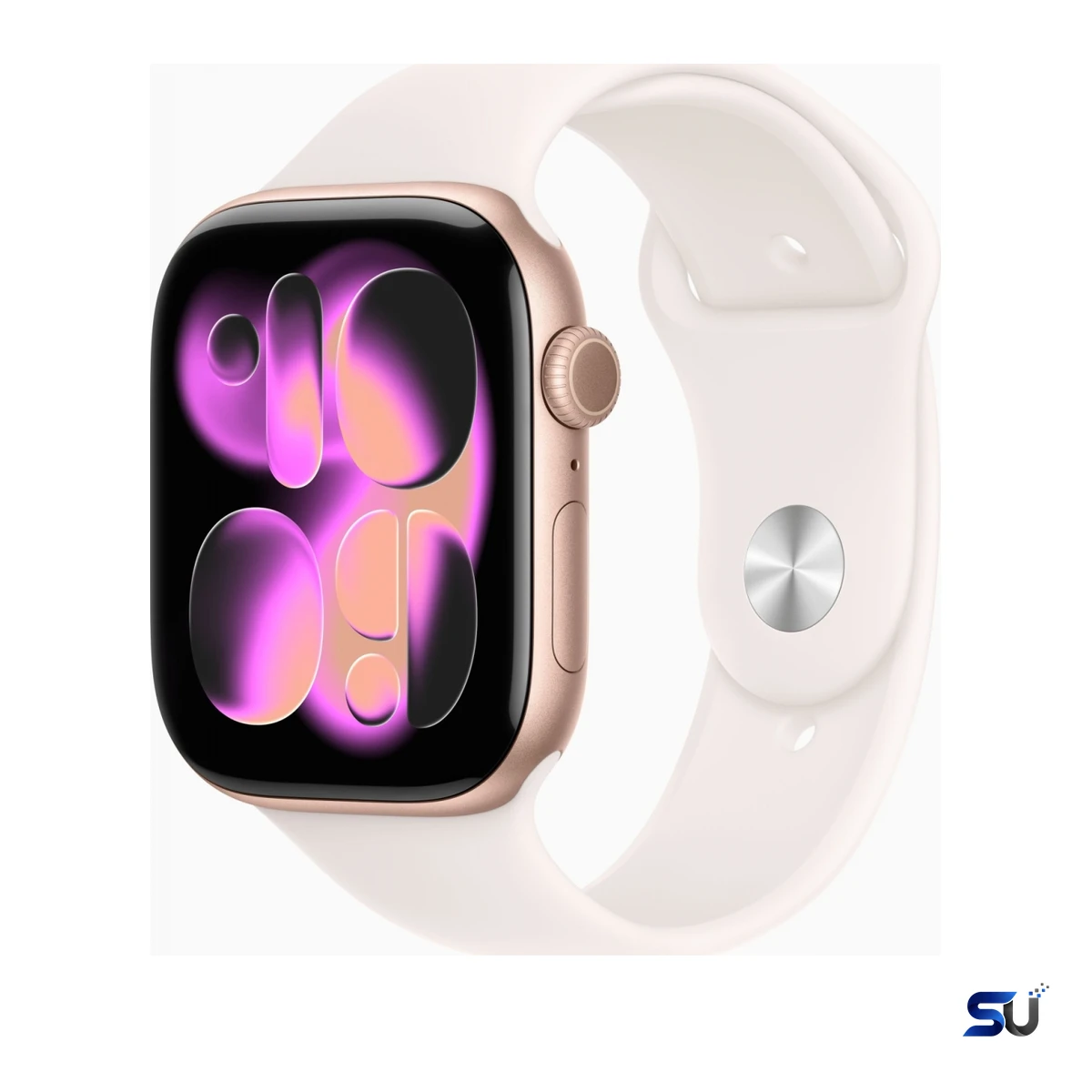
Apple stuck with the formula that works: a 49mm case milled from aerospace-grade titanium, 44mm wide and 12mm thick. In the Natural finish it weighs 61.6 grams; in Black, 61.8 grams. A raised lip around the edge protects the flat sapphire crystal from rocks, doorframes, and weight racks.
This is a large watch, and there’s no point pretending otherwise — Apple says it fits wrists from 130mm to 210mm. If your wrist sits at the smaller end of that range, try one on first. Even so, titanium keeps the weight reasonable and the balance good; it doesn’t feel like a brick.
Apple designed the controls for gloved hands: an oversized Digital Crown with deep grooves, and a side button you’ll find by feel. The orange Action button on the left edge launches workouts, marks compass waypoints, or triggers the siren — and you can customize it in settings. Calls and Siri in wind come through three microphones and dual speakers.
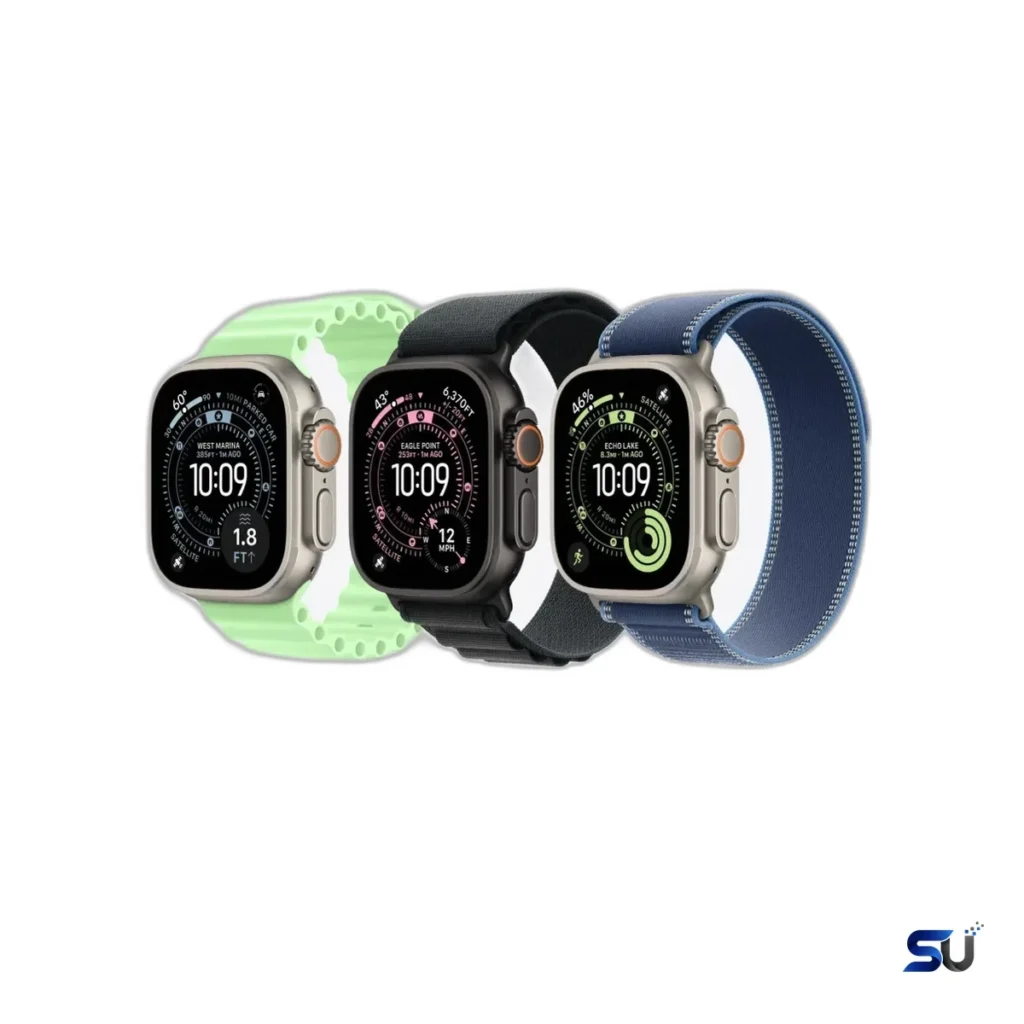
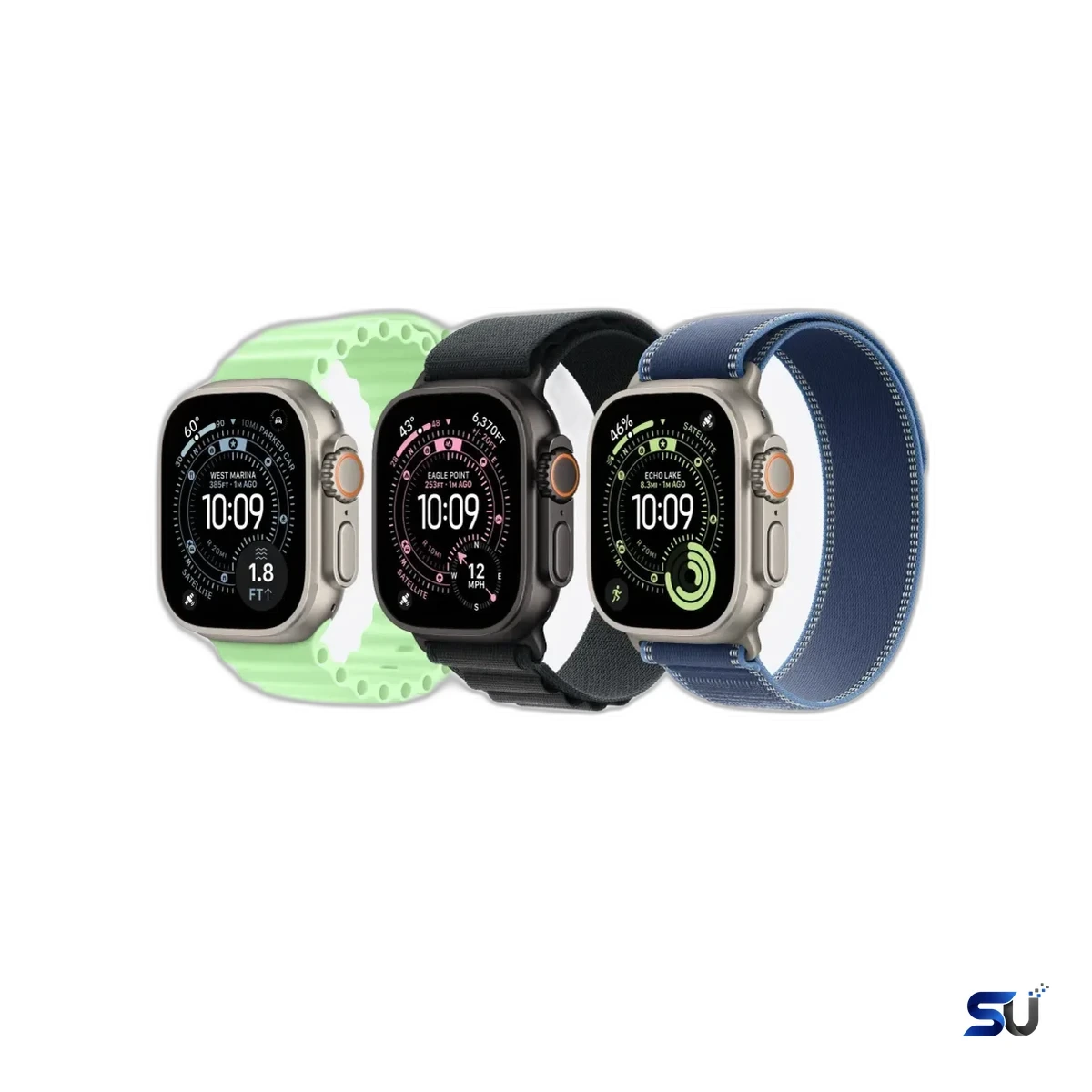
Bands matter more than people expect. The Trail Loop is the lightest and most comfortable for sleep, while the Alpine Loop is rugged and secure for hiking. Divers and swimmers get the Ocean Band, molded for water sports. All three fit the 49mm case, and swapping takes seconds.
Display
The screen is the biggest Apple has ever put on a watch — 1245 square millimeters of flat sapphire crystal, with 422 × 514 pixels at 326 pixels per inch. Text looks razor sharp, and maps show more of the trail ahead.
It’s a wide-angle OLED with LTPO3 — in plain terms, that means two things. The viewing angle is wider, so the screen stays readable when your wrist tilts, and the refresh rate can drop to 1Hz for the always-on display, which sips power instead of gulping it.
Brightness and always-on
Peak brightness hits 3000 nits — the brightest display on any Apple Watch, and it shows. Direct sunlight that washes out lesser screens barely fazes this one. You can read a map or a text at high noon without shading the watch.
At the other end, brightness drops to 1 nit. Apple’s Night Mode turns the Wayfinder and other Ultra faces red in the dark, which is easier on your eyes and doesn’t wreck your night vision. The always-on display, meanwhile, keeps the time, workout stats, and complications visible without a wrist raise.
Performance and storage
The Ultra 3 runs on Apple’s S10 chip. It’s a 64-bit dual-core processor with a 4-core Neural Engine. In daily use, watchOS 26 feels instant — apps open fast, the app switcher doesn’t stutter, and the wrist-flick gesture for dismissing notifications works reliably.
Storage is 64GB, which is generous for a watch — enough for playlists, podcasts, and audiobooks on phone-free runs, with room to spare for offline maps. You can’t expand storage, but 64GB is hard to fill on a wrist.
Precision Finding for a misplaced iPhone 15 or later comes courtesy of the second-generation Ultra Wideband chip: walk around the room and the watch points you toward your phone with an arrow, distance, and haptic feedback. You’ll use it weekly.
On-device Siri processes common requests without an internet connection. Set a timer, start a workout, or check the weather off the grid, and the watch handles it locally.
Apple Watch Ultra 3 49mm satellite connectivity
This is the headline feature — the first of its kind on an Apple Watch. The Ultra 3 connects to satellites when you have no cellular or Wi-Fi signal. Three things work over that connection: Emergency SOS, Messages, and Find My location sharing.
Emergency SOS via satellite contacts emergency services and shares your location when you’re truly off the grid. Messages via satellite lets you text friends and family from the trail. And Find My via satellite updates your location so people can follow your progress. Apple includes two years of satellite service free when you activate the watch.
You’ll need a clear view of the sky, and messages can take a while to send — that’s physics, not a flaw. Satellite connectivity doesn’t replace a dedicated personal locator beacon for serious expeditions. But for day hikers, trail runners, and skiers who previously carried nothing, it’s a real safety layer that weighs nothing extra.
Health and fitness tracking
The Apple Watch Ultra 3 49mm carries Apple’s full health sensor array: a third-generation optical heart sensor tracks heart rate around the clock, the electrical heart sensor powers the ECG app, a blood oxygen sensor feeds the Blood Oxygen app, and skin temperature sensing supports cycle tracking and sleep data.
watchOS 26 adds two new tricks of its own. Hypertension notifications watch for consistent signs of high blood pressure, nudging you to talk to your doctor; sleep apnea notifications take the same approach for breathing disturbances during sleep. These are wellness features that spot trends — they don’t diagnose conditions, and they don’t replace medical care.
Heart, ECG, and blood oxygen
Heart rate zones show live during workouts, while the watch logs resting rate, walking average, and heart rate variability. High and low heart rate notifications can flag unusual readings. The ECG app takes a 30-second reading and can indicate signs of atrial fibrillation. Cardio fitness estimates your VO2 max from outdoor walks, runs, and hikes.
Sleep tracking, sleep score, and new alerts
Sleep tracking records time in REM, core, and deep sleep, plus wake-ups. The new sleep score then boils the night down to one number with plain-language guidance. Sleep apnea notifications can alert you to possible moderate-to-severe sleep apnea over a 30-day window. The Vitals app compares overnight readings — heart rate, respiratory rate, wrist temperature, blood oxygen, and sleep duration — against your typical ranges.
Safety features
Fall Detection calls emergency services if you take a hard fall and don’t respond; Crash Detection covers severe car crashes the same way. Both work through the watch’s cellular connection, so your phone can sit miles away.
Hold the Action button and the built-in siren sounds an 86-decibel tone meant to carry up to 180 meters. If you’re injured on a trail and can’t move, that sound helps rescuers find you. International emergency calling works in many countries even without a local plan.
The Compass app supports waypoints and Backtrack, which retraces your steps along the path you came in on. The flashlight uses the bright display as a light source. Small things — until you need them at dusk on an unfamiliar trail.
Battery life and charging
Apple rates the Ultra 3 at up to 42 hours of normal use — nearly double the Series 11 — stretching to 72 hours in Low Power Mode. For most people, the Apple Watch Ultra 3 49mm means charging every other day instead of every night; for backpackers, a long weekend with one top-up.
Real-world battery life depends on how you use it. GPS workouts, cellular streaming, and the always-on display drain faster, while sleep tracking sips. Run Low Power Mode overnight and you’ll still have plenty left in the morning. The 42-hour figure assumes typical mixed use, and independent tests generally land close to Apple’s claim.
Fast charging helps when you’re in a hurry: fifteen minutes on the charger adds up to 12 hours of use, five minutes adds up to 8 hours of sleep tracking, and a full charge to 80% takes about 45 minutes. The magnetic fast charger to USB-C comes in the box with a 1-meter cable.
Connectivity and iPhone compatibility
Every Ultra 3 has cellular — 5G through RedCap, plus LTE and UMTS, via eSIM, with no physical SIM slot. RedCap is a lighter version of 5G built for wearables: it uses less power than full 5G while delivering far more bandwidth than LTE-M, which is what matters for streaming music or taking calls from your wrist.
Wi-Fi is Wi-Fi 4 on 2.4GHz and 5GHz bands. Bluetooth 5.3 connects headphones, heart rate straps, and power meters; NFC handles Apple Pay and digital keys; and GymKit syncs with compatible cardio equipment with a tap.
You need an iPhone to use this watch — there’s no way around that. It needs an iPhone 11 or later, including the second-generation iPhone SE and newer, running iOS 26 or later, and it doesn’t work with Android phones. Family Setup lets a parent manage a watch for someone without their own iPhone.
GPS accuracy
The Ultra 3 uses precision dual-frequency GPS, receiving both L1 and L5 satellite signals. It also tracks GLONASS, Galileo, QZSS, and BeiDou constellations. Dual-frequency matters because L5 signals resist reflections off buildings and canyon walls better than L1 alone.
In practice, that means cleaner tracks in cities, under tree cover, and along cliff trails. Routes have fewer jagged detours. Pace readings stabilize faster when you start a run. For most runners the difference is subtle; for trail runners and hikers who navigate with the watch, it’s meaningful.
The always-on altimeter tracks elevation gain in real time, while the compass shows incline, elevation, and coordinates at a glance. With downloadable offline maps and custom routes, the Apple Watch Ultra 3 49mm works as a genuine navigation tool, not just a fitness tracker with a map screen.
Water resistance and dive
The Ultra 3 is water resistant to 100 meters under ISO 22810:2010. It also carries an IP6X dust rating and meets MIL-STD 810H for shock and temperature extremes. So it survives rain, sweat, drops, and dusty trails without drama.
Divers get more: the watch meets EN13319, the standard for dive computers, and Apple rates it for recreational scuba to 40 meters. When you submerge, the Depth app shows time, depth, water temperature, and maximum depth automatically, and the Oceanic+ app turns the watch into a full dive computer — fed by a dedicated depth gauge and water temperature sensor.
You can swim with it daily, surf with it, and rinse it under a tap afterward. Still, Apple recommends a rinse after salt water or chlorine. Seals wear over years of use, so the 100-meter rating is a new-watch figure, not a forever promise.
What’s in the box
Here’s what you get:
- Apple Watch Ultra 3 49mm in Natural or Black titanium
- Trail Loop, Alpine Loop, or Ocean Band in your chosen size
- Apple Watch Magnetic Fast Charger to USB-C (1m)
- Quick start documentation
There’s no wall adapter in the box, though — you’ll use your own USB-C charger or plug into a laptop. Bands fit wrists from 130mm to 210mm, so check Apple’s fit guide if you’re between sizes.
Frequently asked questions
Is the Apple Watch Ultra 3 49mm too big for everyday wear?
It depends on your wrist and your tolerance. The 49mm case is the largest Apple makes, and it looks big on wrists under about 150mm. That said, it’s only 12mm thick and the titanium keeps it light at under 62 grams. Many people with medium wrists wear it daily. If you’re unsure, try one on in a store before ordering.
Does the Apple Watch Ultra 3 49mm work with Android?
No. It requires an iPhone 11 or later running iOS 26 or later. It doesn’t work with Android phones, and no iPhone means no setup. Family Setup is the exception — a parent with an iPhone can manage a watch for someone without one.
How is the real-world battery life?
Apple’s 42-hour rating holds up well in normal use — notifications, workouts, sleep tracking, and the always-on display. Heavy GPS days with cellular streaming drain it faster, while light days stretch further. Low Power Mode’s 72-hour figure is realistic without the always-on display and background heart rate alerts.
Can I swim and dive with it?
Yes. It handles 100-meter water resistance for swimming and meets the EN13319 dive standard to 40 meters for recreational scuba. The Depth app and Oceanic+ app handle dive logging. Rinse the watch in fresh water after swimming in the sea or a pool.
What’s the difference between the Ultra 3 and the Apple Watch Series 11?
Size, toughness, battery, and satellite. The Ultra 3 adds a 49mm titanium case, 42-hour battery, 100-meter water resistance, a dive rating, dual-frequency GPS, an Action button, a siren, and satellite connectivity. The Series 11 is thinner, lighter, cheaper at $429, and comes in 42mm and 46mm. For office life and casual workouts, the Series 11 is plenty; for the backcountry, the Ultra 3 earns its keep.
Should Ultra 2 owners upgrade to the Ultra 3?
The honest answer: only for satellite connectivity. The Ultra 3 keeps the same design language and core feature set as the Ultra 2. You get a bigger, brighter display, 5G RedCap, hypertension notifications, and the satellite features. If you spend time beyond cell coverage, that’s a compelling upgrade. If you don’t, the Ultra 2 remains excellent.
Specification source
Specs on this page come from Apple’s official Apple Watch Ultra 3 tech specs (support.apple.com) and September 2025 launch materials. Pricing reflects the United States market; battery figures are Apple’s rated numbers for typical use.