Overview
The Apple Watch Series 11 46mm refines rather than reinvents. A brighter wide-angle OLED display, the S10 chip, and new sleep apnea notifications join the familiar lightweight aluminum design — the default smartwatch recommendation for iPhone owners.
What didn't change matters too: Apple kept the S10 chip — the same 64-bit dual-core processor, 4-core Neural Engine, and 64GB of storage as the Series 10. If you were hoping for a performance leap, this isn't it. Instead, you're getting a more polished version of an already good watch, with better battery life, faster charging, and tougher glass.
In the US, the 46mm aluminum GPS model starts at $429 — about $30 more than the 42mm. That puts it in familiar flagship smartwatch territory: well under the Ultra, and in line with rival large-size models.
Bottom line: the 46mm Series 11 is the safe, sensible pick — a bigger screen than the 42mm, battery that covers day and night, and genuinely useful health additions, all in a thin, light case that disappears on the wrist.
Design and comfort
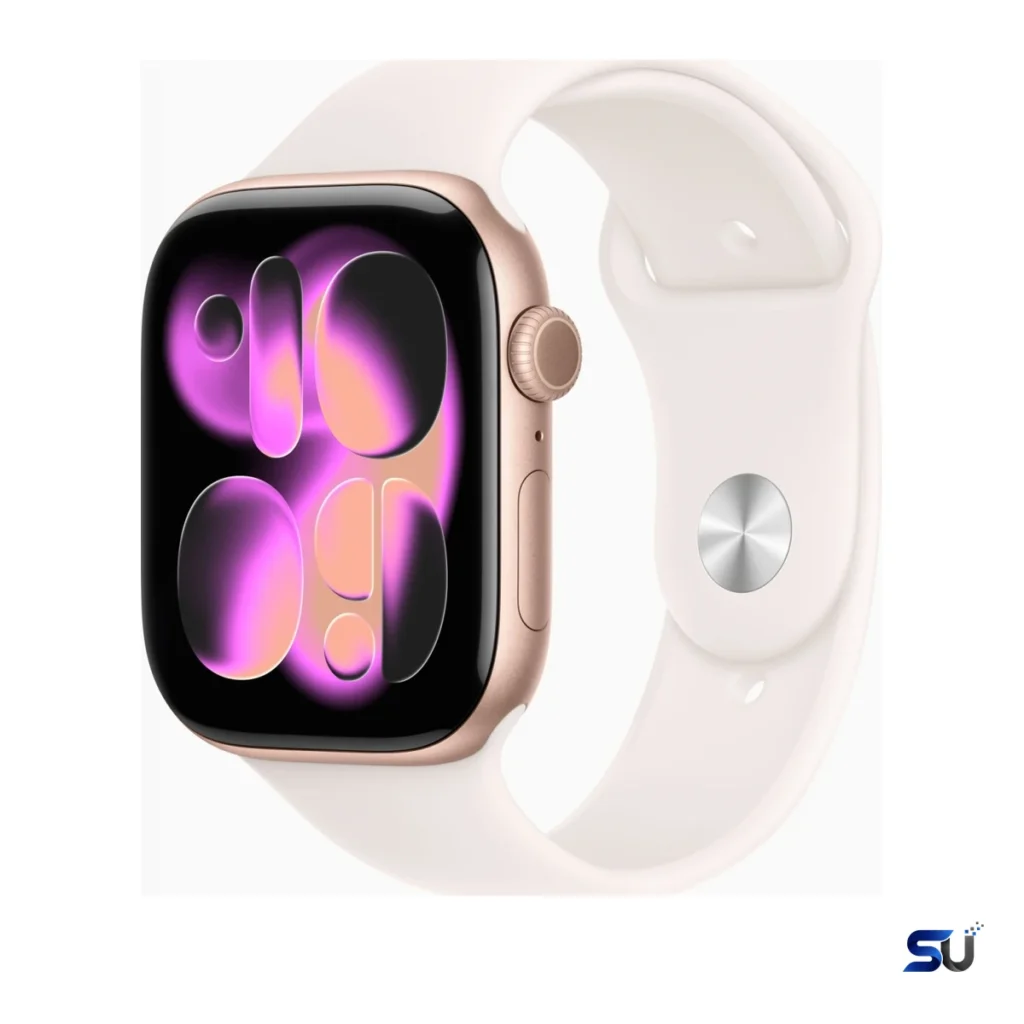
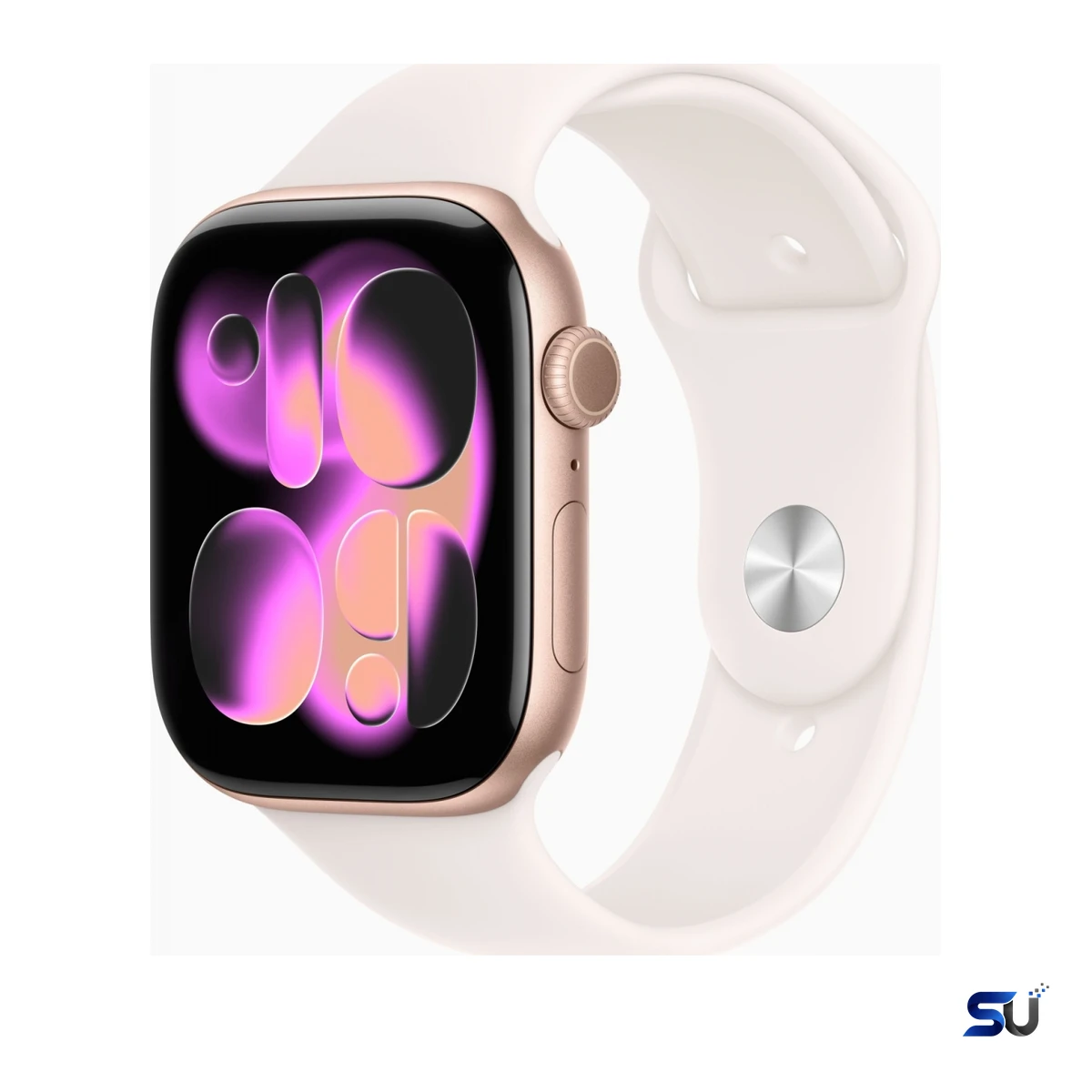
Measuring 46 by 39mm and just 9.7mm thin, this is one of the slimmest full-size smartwatches you can buy. Yet it wears smaller than the numbers suggest: the case curves into the strap, and the display runs nearly edge to edge. The aluminum GPS model weighs 37.8 grams; the cellular version, 36.9 grams. It's light enough to forget during the day and slim enough not to catch on shirt cuffs.
Jet Black, Rose Gold, Silver, and Space Gray are the aluminum colors, with a titanium version in Natural and Slate. The titanium costs more and weighs 43.1 grams. The Digital Crown and side button sit where they always have — if you're coming from a Series 7 or later, it'll feel instantly familiar.
Sleep tracking makes comfort a real priority, and the thin, light build helps. Pair it with a soft sport loop and most people can wear it all night — which matters, because the sleep score and sleep apnea notifications only work if the watch stays on your wrist. Bands use the same connector as recent models, so 46mm Series 10 and 45mm Series 7–9 bands carry over. If you've built a collection, nothing goes to waste.
Display
Screen size is the main reason to choose this size: 416 by 496 pixels across about 1220 square millimeters of viewing area. That means more text in Messages and Mail, bigger touch targets, and a keyboard that's genuinely usable for quick replies. It's an LTPO3 OLED panel that drops to a very low refresh rate for static content, then ramps up when you scroll — efficiency that's one reason battery life improved without a bigger battery. Text stays sharp at 326 pixels per inch, colors are rich, and blacks are properly black.
Brightness and always-on
Peak brightness reaches 2000 nits — plenty for reading the time in direct sun — and it can dim to 1 nit in the dark, so a 3am time check won't blast your eyes. The always-on mode keeps the watch face visible, and the wide-angle OLED stays readable at an angle. Aluminum models get Ion-X glass, which Apple says is twice as scratch-resistant as before; titanium gets sapphire crystal instead. Neither is unbreakable, but both should look better for longer.
Performance and storage
Under the hood, the S10 SiP is unchanged from the Series 10: a 64-bit dual-core processor with a 4-core Neural Engine. In practice, that's plenty — apps open fast, Siri responds promptly, and watchOS 26's on-device features run smoothly. The new wrist-flick gesture works without lag, for example. Apple doesn't publish RAM figures for watches; storage is 64GB, enough for playlists, podcasts, and offline maps. There's no expansion slot, though that's true of every Apple Watch.
Coming from a Series 10, you won't feel a speed difference — there isn't one. From a Series 6 or older, though, everything feels faster: the chip, the display, the responsiveness. It's a meaningful step up.
Health and fitness tracking
Health-wise, the sensor array carries over: a third-generation optical heart sensor, an electrical heart sensor for ECG, plus blood oxygen, temperature, compass, always-on altimeter, high-g accelerometer, high dynamic range gyroscope, ambient light sensor, depth gauge, and water temperature sensors. These are consumer fitness and wellness features, not medical devices — they can flag things worth discussing with a doctor, but they don't diagnose on their own.
Heart, ECG, and blood oxygen on the Apple Watch Series 11 46mm
Background heart-rate readings come from the Heart Rate app, which can alert you to unusually high or low rates while you're inactive. Irregular rhythm notifications watch for signs of atrial fibrillation. The ECG app takes a 30-second reading via the Digital Crown and saves a PDF you can share with your doctor. The Blood Oxygen app measures SpO2 for a general picture of respiratory fitness.
New here are hypertension notifications: the watch analyzes trends over time and can alert you to consistent signs of high blood pressure, then prompts a checkup. It's a screening nudge, not a cuff replacement — but for a condition that often has no symptoms, that nudge has real value.
Sleep tracking, sleep score, and new alerts
The Sleep app tracks time in bed and stages — awake, REM, core, and deep — and watchOS 26 adds a nightly sleep score that rolls duration, consistency, and interruptions into one number. A quick glance tells you whether last night was restorative. Sleep apnea notifications look for breathing disturbances over time and suggest talking to a doctor if they see consistent signs. You'll need to wear the watch at night; the good news is five minutes on the charger covers a full night of sleep tracking.
Safety features
Apple's full safety toolkit comes standard on the Series 11. Fall detection watches for hard falls and can call emergency services if you don't respond. Crash detection does the same for severe car crashes, using the high-g accelerometer, gyroscope, microphone, and barometer together. Emergency SOS calls for help when you hold the side button, and it can share your location with emergency contacts.
These run in the background with nothing to turn on — though it's worth knowing they exist. For older adults — or anyone who spends time alone outdoors — they're a genuine reason to keep the watch on. The cellular model can call for help even without your phone nearby, and it can notify your emergency contacts automatically: if fall detection triggers a call, your designated contacts get a text with your location, so help can reach you even if you can't communicate.
Battery life and charging
Apple rates the Series 11 at up to 24 hours of normal use — up from 18. That's the difference between ending the day in the red and ending it comfortably, and it makes overnight sleep tracking realistic without midday charging. Low Power Mode claims up to 38 hours by cutting background features — a handy fallback for long travel days.
In the real world, life varies: cellular streaming drains faster, long GPS workouts drain faster, and the always-on display uses more too. Still, a typical day fits honestly within the rating — notifications, a workout or two, and sleep tracking overnight. It's not multi-day Garmin territory, but it finally covers a full day-plus-night cycle.
Charging is faster too: 0 to 80 percent in about 30 minutes with the included magnetic fast charger, and fifteen minutes buys up to 8 hours of use. The 1-meter USB-C cable is in the box; you supply your own wall adapter. Apple doesn't publish the mAh capacity — that's normal for watches.
Connectivity and iPhone compatibility
Cellular models gain 5G via RedCap, a lighter 5G variant built for wearables — more about efficiency and future-proofing than raw speed. LTE is still there as well. Both versions get Wi-Fi 4 on 2.4 and 5GHz, Bluetooth 5.3, a second-generation Ultra Wideband chip, NFC for Apple Pay, and GymKit. GPS covers L1 plus GLONASS, Galileo, QZSS, and BeiDou, so route tracking works worldwide without your phone.
On compatibility: you need an iPhone 11 or later running iOS 26 or later, and there's no Android support. Family Setup lets you provision a watch for a child or relative from your iPhone, and cellular models support international roaming — handy for travel.
Water resistance and everyday durability
Water resistance is rated to 50 meters, covering pool and open-water swimming, showers, and rain. A depth gauge reads to 6 meters, a water temperature sensor logs conditions, and Water Lock ejects water from the speaker after swims. Skip scuba diving and high-velocity water sports, though. Dust resistance is IP6X — the top rating — so beach sand and trail dust aren't worries.
Picking the 46mm size
Choosing between 42mm and 46mm comes down to wrist size and screen preference. The 46mm fits wrists from about 140 to 245mm; under ~150mm, the 42mm looks more proportional. There's no spec difference beyond display, battery, and dimensions — same chip, same sensors, same features — so it's purely fit and taste. The $30 gap shouldn't decide it; get the one that feels right. If you plan to track sleep, consider comfort carefully: the thin 46mm case helps, but the larger footprint can still bother side sleepers with small wrists. Trying both sizes in a store is worth the trip. Either way, you're getting the same watch — just sized to your wrist.
What's in the box
Apple keeps the package simple. Here's what you get:
- Apple Watch Series 11 46mm
- Band in your choice of style and size
- 1-meter Apple Watch Magnetic Fast Charger to USB-C cable
- Quick start guide
No wall adapter is included, so you'll need your own USB-C power brick. Any standard USB-C charger works, though Apple's own adapters guarantee the fastest charging speeds. The band attaches with Apple's slide-in connector, so swapping it takes seconds.
Frequently asked questions
Is the Apple Watch Series 11 46mm too big for small wrists?
It can be: it fits wrists from about 140mm, but on smaller wrists it looks oversized and can dig in when you bend your wrist. Under ~150mm, the 42mm is the safer pick — same tech, just scaled down.
Does the Apple Watch Series 11 46mm work with Android?
No — it needs an iPhone 11 or later running iOS 26 or later. Android users should look at the Galaxy Watch or Pixel Watch instead. This isn't likely to change.
How long does the battery actually last?
Apple's 24-hour rating holds for typical days: notifications, a workout or two, and sleep tracking overnight. Heavy GPS or cellular streaming drains it faster, while Low Power Mode stretches it to a claimed 38 hours. Expect to charge daily — though a 15-minute top-up gives hours of use.
Can you swim with the Apple Watch Series 11 46mm?
Yes — it's rated to 50 meters, with swim workout modes, a depth gauge, and water temperature readings. Rinse with fresh water after ocean or pool swims. Skip scuba diving and water skiing; it's not rated for high-pressure water.
What's the difference between GPS and cellular models?
The GPS model needs your iPhone nearby or Wi-Fi for calls, messages, and data. The cellular model has its own 5G/LTE via eSIM, so it works independently — handy for phone-free runs. It costs more upfront, and there's a carrier plan (around $10/month in the US). If your phone's always with you, GPS saves money.
Is it worth upgrading from the Apple Watch Series 10?
For most Series 10 owners, no: same chip, same display, same design. The gains — battery life (24 vs 18 hours), faster charging, tougher glass, 5G, and new health features — are nice refinements, not a reinvention. It makes more sense from a Series 9 or older, where the thinner case, bigger screen, and battery gains add up.
Specification source
Specs here are drawn from Apple's official technical specifications for the Apple Watch Series 11, published on support.apple.com. US pricing and availability are included as well. Where Apple doesn't disclose a figure, that's noted — nothing is estimated.